A Claim Is Not Yet a Conclusion
Learn to separate a report’s observable facts from the conclusion drawn from them, so you can see what the evidence supports and what remains uncertain.
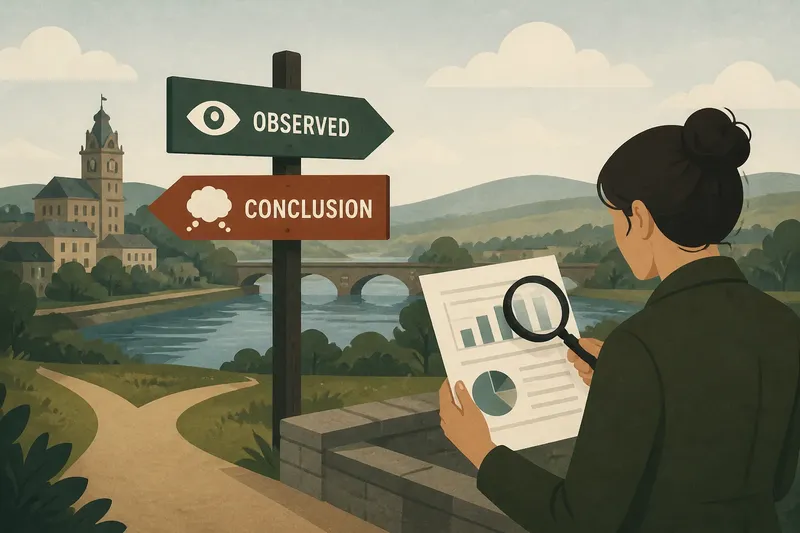
A council report says that more residents used the library last month than in the month before. That is a claim about a recorded change; it does not, by itself, show that a new evening opening caused the increase. Reading news claims carefully means noticing the distance between what was observed and what someone concludes from it.
What is the difference between a claim and a conclusion?
A claim states something that can be assessed against evidence. A conclusion interprets evidence and offers a broader explanation, judgement or prediction. The two may appear in neighbouring sentences, but they do different work.
In a report, “the river rose after heavy rain” describes an observed sequence. “The new drainage scheme failed” assigns a cause and a verdict. The second statement may be reasonable, but it needs more support than the sequence alone supplies.
Claims can be narrow or broad. “The survey recorded fewer responses this year” is narrow enough to check against the survey. “Public trust has collapsed” is broader: a reader needs to ask what was measured, whose trust is meant and how the conclusion follows.
How do I identify what was actually observed?
Look for the smallest statement in the report that could be checked without adopting its interpretation. It may describe a count, a document, a recorded event, a direct observation or what a named person said. Keep the wording precise: “the agency announced a review” is not the same as “the agency admitted wrongdoing”.
Separate the source of the observation from the fact itself. A reporter may describe seeing a road closed; a council notice may record that it was closed; a resident may say the closure caused a long delay. Those are distinct pieces of information, not interchangeable versions of one fact.
Words such as “because”, “therefore”, “proves”, “signals” and “will” often mark a move from observation towards inference. They do not make the inference false. They do tell you where to pause and ask what connects the evidence to the conclusion.
What does the evidence support, and what does it not?
Evidence supports a conclusion when it bears on that conclusion, and when the reasoning connecting the two is clear enough to examine. A document may establish that a decision was made; it may not establish why it was made. A rise in reported complaints may establish that more complaints were logged, not necessarily that the underlying problem became more common.
Try asking three questions as you read:
- What is directly documented? Find the record, statement or observation the report relies on.
- What additional interpretation is being offered? Notice any cause, motive, trend or forecast.
- What would have to be true for that interpretation to follow? Identify any missing link, such as a comparison, a reliable measure or evidence that rules out another explanation.
This is not a demand to reject every interpretation. It is a way to give each sentence the right weight. A well-supported conclusion can still involve uncertainty; a plausible conclusion is not automatically an established fact.
Can a true fact still be used to suggest too much?
Yes. A fact may be accurate while its placement or description encourages a larger inference than it can carry. The issue is not necessarily whether the fact is true, but what the reader is invited to take it as evidence of.
Imagine a school announces that attendance improved during a term when it also began sending text reminders to families. The increase and the timing may be observable. Saying the messages caused the improvement requires more: for example, a basis for distinguishing their effect from other changes during the term.
The same caution applies to comparisons. “More people applied this year” is incomplete unless the relevant period and population are clear. An increase in applications does not, by itself, establish that more people were eligible, that more were approved or that the policy worked as intended.
A useful analogy is a jigsaw piece: a real piece can fit one part of the picture without showing the whole scene. One vivid fact may deserve attention, but it cannot stand in for evidence about the wider pattern.
How can I tell whether a cause has been established?
A report supports a causal conclusion when it does more than show that one event came before another. It should give readers a reason to think the earlier event contributed to the later one, rather than merely occurring alongside it.
Ask what other explanations might account for the same observation. If a shop’s queues shorten after it changes its opening hours, staffing changes, seasonal demand or a nearby road closure might also matter. Naming alternatives does not disprove the proposed cause; it shows what the evidence needs to address.
Notice how confidently the report describes the connection. “After the change, waiting times fell” states a sequence. “The change reduced waiting times” states a cause. “The change may have helped reduce waiting times” signals a more limited interpretation. These formulations are not equivalent, even when they refer to the same observation.
What should I ask when a report moves from evidence to inference?
Does the evidence measure the thing named in the conclusion?
Check whether a measure matches the claim. A count of website visits can describe visits, but it does not directly measure comprehension, approval or lasting engagement.
Is the comparison fair?
Look for a like-for-like comparison: similar periods, populations and ways of counting. If those conditions differ, the contrast may still be informative, but its limits should be clear.
Are other explanations considered?
For claims about causes, look for discussion of plausible alternatives. A report that acknowledges them gives you a clearer view of what has and has not been ruled out.
Does the wording match the strength of the evidence?
Words such as “shows”, “suggests” and “could” signal different levels of confidence. Ask whether the underlying evidence justifies the wording, rather than treating forceful phrasing as proof.
How should I handle a conclusion that remains uncertain?
Keep the observation and the interpretation in separate mental notes. You might say, “The council recorded fewer missed collections; it attributes the change to a new route plan.” That phrasing preserves the recorded result while making clear who is offering the explanation.
Then ask what further evidence would help. A consistent measure over time, a comparison with a similar area or a document explaining how the decision was assessed might clarify the issue. If the report does not provide that information, “not established here” is more accurate than either “certainly true” or “false”.
Uncertainty is not a reason to stop reading, nor does it make every interpretation equally credible. It marks a boundary: what the available evidence lets you say, and what would require more. If a claim has practical consequences, seek the relevant primary document or a qualified expert rather than relying on a compressed news summary.
How can I phrase the distinction when discussing a story?
Use wording that names the evidence before the inference. “The report records a rise in applications and argues that the new service contributed” is more exact than “the service brought in more applicants”, unless the causal link has been established.
For a claim you doubt, avoid replacing it with an equally unsupported counterclaim. You can say, “The figures show an increase, but this report does not establish what caused it.” That is a substantive reading, not a retreat from judgement.
The claim-versus-conclusion test is especially useful when a story compresses several reasoning steps into a short sentence. Separate the recorded fact, identify the interpretation, and inspect the link between them. The result is a more careful account of what the news supports—and a clearer sense of what remains open.