A Sunday News Catch-Up Without the Scroll Spiral
A Sunday news catch-up can keep you informed without the scroll spiral: choose a few stories, read beyond the headline and record what remains unclear.
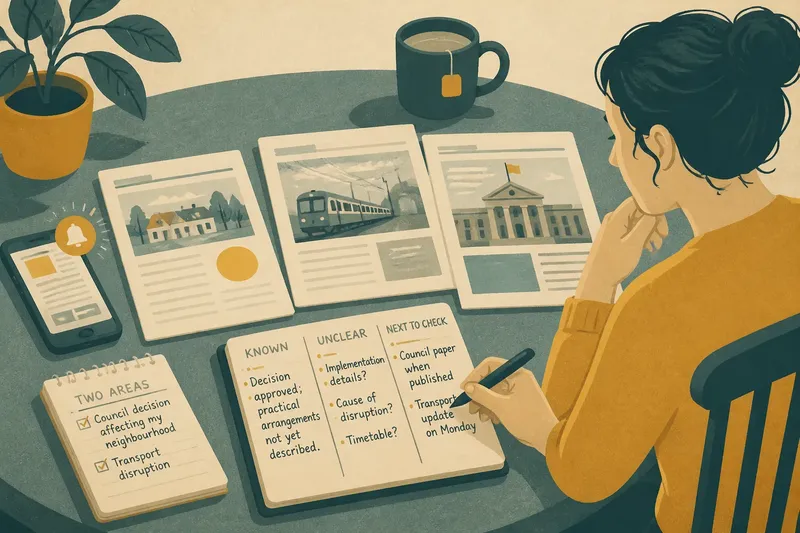
At the kitchen table on Sunday, a phone lights up beside a cooling mug of tea. One alert leads to a homepage, then to a string of headlines that seem to demand attention all at once. A Sunday news catch-up works better when it has an edge: a few chosen stories, read with care, and a deliberate point at which to stop.
The aim is not to know everything that happened. It is to leave with a useful account of a small number of developments and a clear sense of what is still uncertain. The routine below follows one invented situation, then draws out the choices that make it manageable.
How does the Sunday news catch-up begin?
Imagine Mara, who has a quiet hour at home and has missed the week’s public-affairs coverage. She opens a local newspaper’s weekly briefing and a public broadcaster’s news page, rather than starting with an endlessly refreshed feed. Before reading, she writes down two areas she genuinely wants to follow: a council decision affecting her neighbourhood and a continuing transport disruption.
That small choice gives her a boundary. She scans the pages for developments within those areas and selects one story about each, along with one national story that has clear consequences for people in her region. A striking headline outside those interests may be worth returning to later, but it does not automatically enter this sitting.
Mara also decides what counts as enough: one substantial report per chosen story, plus a second source only if it helps clarify a particular point. This is not a rule for everyone. It is a starting arrangement that keeps curiosity from being mistaken for an obligation to click.
How can a reader choose a small set of stories?
Selection is a judgement about attention, not a verdict on importance. Mara favours stories that describe a consequential change, give enough information to understand what happened, or bear on a question she is already trying to follow. She leaves aside near-identical updates that add no new decision, document or explanation.
A useful screen is to ask what each story would add to the hour. Does it report a new action, explain a consequence, or help make sense of a continuing issue? If the answer is only that it is prominent or alarming, she can note the headline without treating it as a task.
Her selected stories are a council vote, the transport disruption and a report on a proposed change to a public service. The set is small enough to read beyond its headlines, yet varied enough to give her a grounded sense of the week. The number itself matters less than leaving room for attention.
What should happen after a headline?
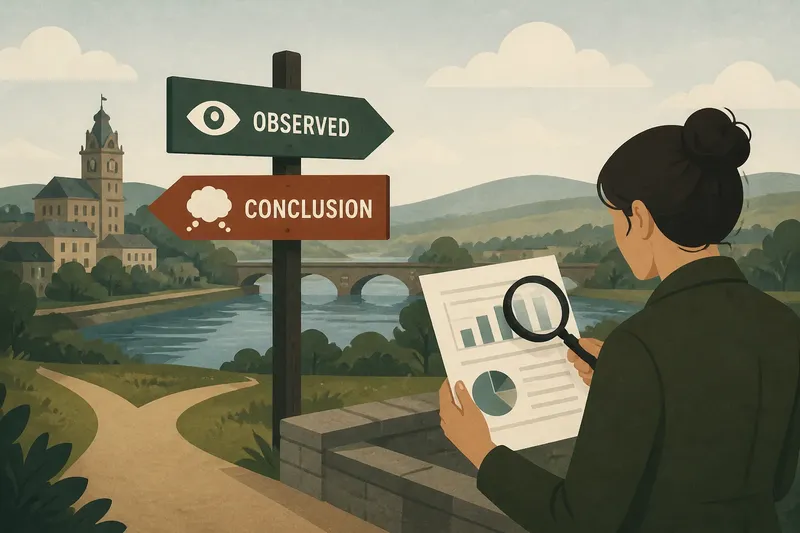
For each selection, Mara reads the report’s opening, the paragraphs that explain the central development, and the ending, where limitations or next steps may appear. She notes who has taken an action, what evidence the report presents and what the article does not yet establish. If the story refers to a council paper or an official announcement, she may open that source to check the wording of the decision.
She does not treat a second article as a vote that settles the matter. Instead, she compares what it adds: perhaps a local outlet explains the effect on residents, while a national report provides the wider policy setting. When both repeat the same statement, that repetition tells her less than an independent document or a clearly different account would.
Say Mara reads that the council has approved a change to a local service, but the report says the implementation details are still being worked out. She writes, “Decision approved; practical arrangements not yet described,” and expects that note to remind her not to infer how the change will work for residents. That is a useful result even though it is not a complete answer.
How should unresolved points be recorded?
Mara keeps a short note for each story, using three plain labels: known, unclear and next to check. Under “known” she records the reported decision or event; under “unclear” she puts the missing detail; under “next to check” she names a likely source or future development, such as the publication of a council document.
This is not a case file to maintain indefinitely. It is more like a shopping list with only a few items: each entry should help her remember what matters, not invite another hour of searching. If no sensible next source is apparent, she can leave the question open rather than inventing a research task.
Her transport note might say that service disruption has been reported, while the cause and expected restoration remain uncertain. She avoids copying a predicted timetable from a headline if the article itself describes it as tentative. The note preserves the difference between an event and a forecast.
When should the catch-up stop?
Mara finishes when each selected story has a basic account, any important uncertainty has a place in her notes, and another click seems unlikely to change her understanding. She closes the tabs rather than following every related link. If a major new detail appears later, she can return to that story with a specific question instead of restarting the whole feed.
A natural stopping point also protects the next part of the day. The intention is not to feel fully informed about every subject; that feeling can encourage endless checking. It is to know what she read, what it supports, and where her knowledge ends for now.
What questions help keep the routine steady?
How many stories should a Sunday news catch-up include?
Choose a small set that leaves enough time to read each report attentively. If the last story receives only a glance, reduce the set next time rather than rushing through it.
Should every story be checked against another source?
Not necessarily. Seek another source when a point is consequential, unclear or dependent on a single account, and look for what the second source adds rather than merely counting agreement.
What if a story has no clear answer yet?
Record what is established and name the unresolved point in ordinary language. An open question is a legitimate outcome, not a reason to keep refreshing until a definitive answer appears.
What belongs on the list for next week?
Keep only developments that could materially clarify the story, such as a published decision or a stated review. If the issue no longer matters to your interests or circumstances, let the note go.
What does Mara leave the table knowing?
By the time the tea has gone cold, Mara has read three reports closely enough to distinguish reported events from unfinished questions. She knows which local decision was made, that transport disruption continues, and that a service proposal still lacks practical detail. She has not resolved every issue, nor does her note pretend otherwise.
That is the useful shape of a Sunday news catch-up: a bounded selection, attention beyond the headline and a record of uncertainty that does not turn into a demand for instant closure. Like placing a bookmark in a book, stopping marks where to resume; it does not claim the story has ended.