When a Headline Makes the Story Sound Settled
Learn to read a headline that sounds settled beside a cautious article, and spot how verbs and missing qualifiers change the apparent certainty.
You open a news alert while waiting for the kettle: “New report proves the policy works.” In the article, the report describes an early association, notes limits and says further evaluation is needed. That mismatch is not a small editing quirk. A headline can turn a qualified account into a settled verdict before you have read a sentence of the story.
When a headline makes the story sound settled, the useful question is not simply whether it is “accurate”. Ask what degree of certainty the wording signals, what the article can actually support, and where the shift occurred. A few deliberate checks can help you read the headline without letting it set the limits of the evidence.
Why does the headline feel more certain than the article?
Headlines compress. They have little room for conditions, caveats and distinctions, while the article can explain them in full. Compression becomes distortion when it removes the very words that tell readers how firm a finding is: “may”, “in this sample”, “preliminary” or “according to the authors”.
Editors also have to make a story legible at a glance. A short, active verb can do that quickly, but it may carry a stronger claim than the body supports. “Suggests” and “proves” are not interchangeable shorthand; they describe different relationships between evidence and conclusion.
There is a practical reason the mismatch can be hard to spot. Readers often see a headline on its own, in a notification or social post, before they can inspect the article. The headline then supplies the first frame: later qualifications may feel like details around a conclusion already delivered.
What should you check first?
Start with the main verb. Look for words such as “confirms”, “ends”, “solves”, “causes” or “proves”, and ask what the article says happened. Does it report a link, an estimate, a proposal, a forecast or a completed result? If the verb suggests a final answer while the story describes an interim signal, the headline has raised the certainty.
Next, look for qualifiers that may have disappeared. A result could apply to a particular group, a limited period or a specific measure. Those boundaries are not decorative: “a change in reported symptoms” is not the same as “a cure”, and “among surveyed households” does not mean “among everyone”.
Then locate the sentence that supports the headline. It may be near the top, but do not assume the first paragraph contains the strongest evidence. Read the surrounding lines, including any sentence that says what the result cannot establish. A qualification buried well below a sweeping headline still matters to the claim readers take away.
Which wording changes the level of certainty?
Verbs create a ladder of confidence. “Could”, “may” and “is associated with” leave room for uncertainty; “indicates” or “suggests” make a firmer but still limited statement; “shows” can sound conclusive; “proves” implies a much higher bar. This is not a universal dictionary: context and the kind of evidence matter. But when a headline climbs that ladder, check whether the story climbs with it.
Nouns and omitted conditions can shift meaning just as much. Calling a proposal a “ban” may imply an enacted rule. Calling an estimate a “count” can make an uncertain total sound exact. Removing “in a small trial” or “for people with this condition” can make a narrow finding appear universal.
Attribution matters, too. “Officials say the measure is working” reports a speaker’s claim; “the measure is working” presents that claim as the publication’s own description. If the article attributes a conclusion to a report, a spokesperson or a group of researchers, notice whether the headline preserves that distance.
What can you do when the wording and story diverge?
Use a short sequence rather than rereading the whole article in search of a verdict:
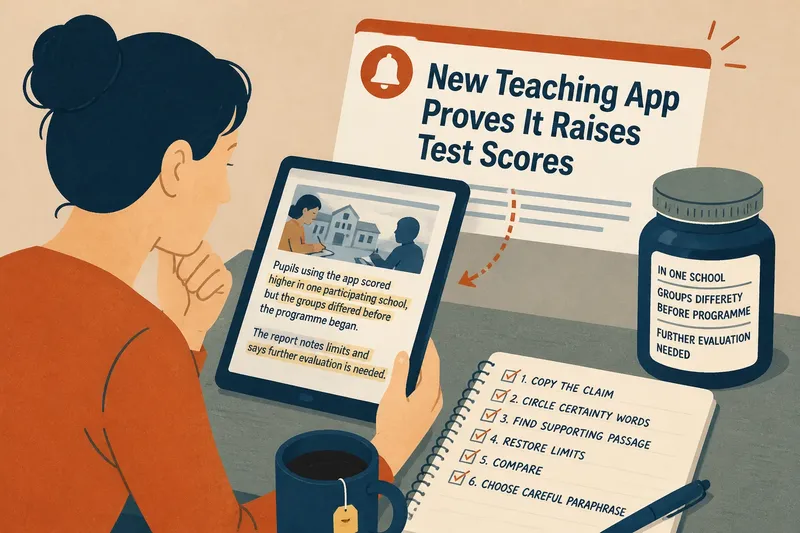
- Copy the headline’s claim in plain language. Identify what it says has happened, changed or been established.
- Circle the certainty words. Include the main verb and any words such as “all”, “only” or “now”.
- Find the supporting passage. Read the relevant paragraph with the sentence before and after it.
- Restore the missing limits. Add the group, time period, measure or attribution stated in the article.
- Compare the two versions. Decide whether the headline is a fair compression, a stronger interpretation or a different claim.
- Choose a careful paraphrase. Keep the article’s level of certainty when you discuss or share the story.
Say you see a headline claiming that a new teaching app “raises test scores”. The article says pupils using the app scored higher in one participating school, but it also notes that the groups differed before the programme began. A careful paraphrase would say the report describes higher scores among those pupils, while the article does not establish that the app caused the difference.
This distinction is like reading a jar label after seeing a bold sticker on the lid. The sticker may be easy to notice, but the smaller wording tells you what is actually inside and what the claim applies to. Here, the article’s qualifying language is part of the claim, not fine print to discard.
What if the article itself does not settle the point?
Sometimes the story is cautious because the evidence is incomplete, the outcome is contested or the relevant information is not yet available. Do not force a binary verdict from that uncertainty. You can say that the headline overstates what the article supports, or that the article reports a preliminary finding without establishing its cause.
If the mismatch seems substantial, check whether the headline has been updated, whether it is an alert or a social-media caption rather than the article’s own headline, and whether the body contains a correction or editor’s note. Different versions can circulate, so compare the wording attached to the story you actually read.
For a quick reference, ask these questions:
Does “proves” mean the article establishes cause?
Not necessarily. Check whether the story describes evidence that can support a causal conclusion or only a link, observation or reported interpretation.
Can a headline omit “may” or “could”?
It can, but the omission changes the apparent confidence. If the article retains that uncertainty, keep it when you restate the finding.
What if the article gives no clear supporting sentence?
Do not fill the gap with a stronger interpretation. Treat the headline as an assertion whose basis is unclear, and look for the relevant source material or a fuller account before repeating it as fact.
Should I share a headline I think is misleading?
If you share the article, add a brief note that reflects its actual limits rather than repeating the stronger wording. If the mismatch is central and cannot be clarified, it may be better not to circulate the headline on its own.
How can you describe the story without overstating it?
Use verbs that match the article’s own account: “reports”, “estimates”, “suggests”, “links” or “attributes”, as appropriate. Keep the relevant qualifier close to the claim, not in a later sentence where it can be missed. If the story says a result is preliminary, say so in the same breath.
A headline is a doorway, not a ruling. Reading its verbs against the article’s qualifications helps you notice when the doorway has made a tentative account look final. When you pass the story on, preserving that distinction is a small but useful act of accuracy.